
Critical journeys are not covered by clear acceptance evidence.
Quality engineering / release evidence
Make release readiness visible before risk reaches production.
Turn defects, acceptance gaps and delivery uncertainty into reproducible evidence, clear ownership and a controlled recovery path.
Discuss your project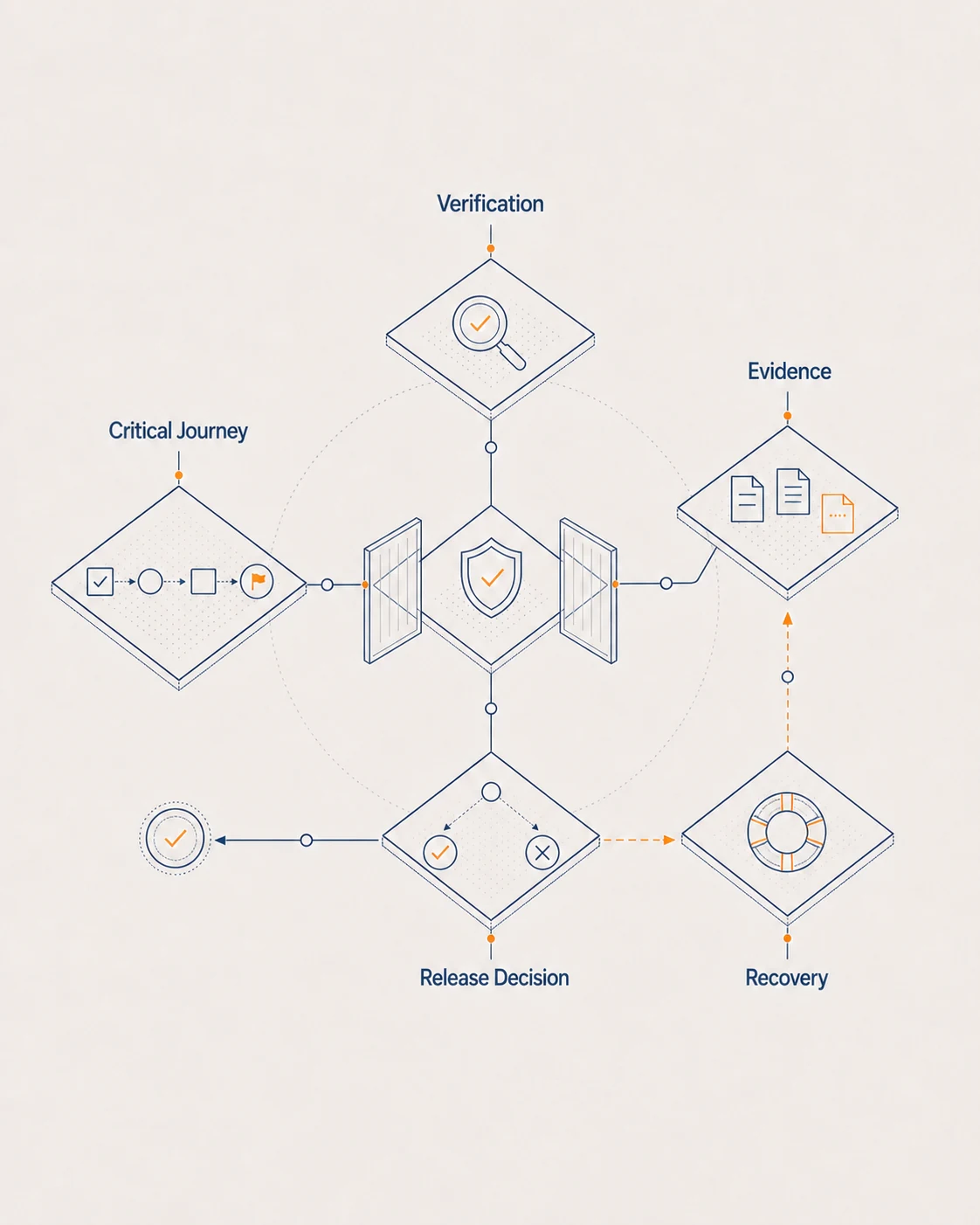
Good fit when
When release confidence is difficult to prove
Defects are difficult to reproduce, prioritize or assign.
A delayed or unstable release needs a controlled recovery decision.
Decision structure
What needs clarity first?
What must work
Define critical journeys, risks and acceptance conditions.
How failure is reproduced
Capture observable steps, dependencies and evidence.
Who accepts the release
Make business and technical ownership explicit.
What can be rolled back
Identify release boundaries, recovery choices and decision gates.
Verification path
From critical journey to release decision
- 01
Define
Agree the critical journeys, risks and acceptance model.
- 02
Verify
Test the approved scope and capture reproducible evidence.
- 03
Decide
Review defects, dependencies and release readiness.
- 04
Recover
Sequence controlled fixes or rollback options when needed.
What you receive
Evidence shaped around the release risk
Outputs depend on the critical journeys, available environments and approved verification or rescue scope.
- Risk-based test and coverage plan
- UAT traceability and acceptance pack
- Release-readiness checklist
- Defect or technical-recovery brief
Release framework
Tie risk, evidence, acceptance and recovery together.
Use the release view to connect critical journeys, verification, acceptance evidence, release decisions and recovery options.
Release confidence
Turn release uncertainty into a clear decision.
Share the critical journey, release concern or reproducible issue that needs attention.
Discuss your project